Description
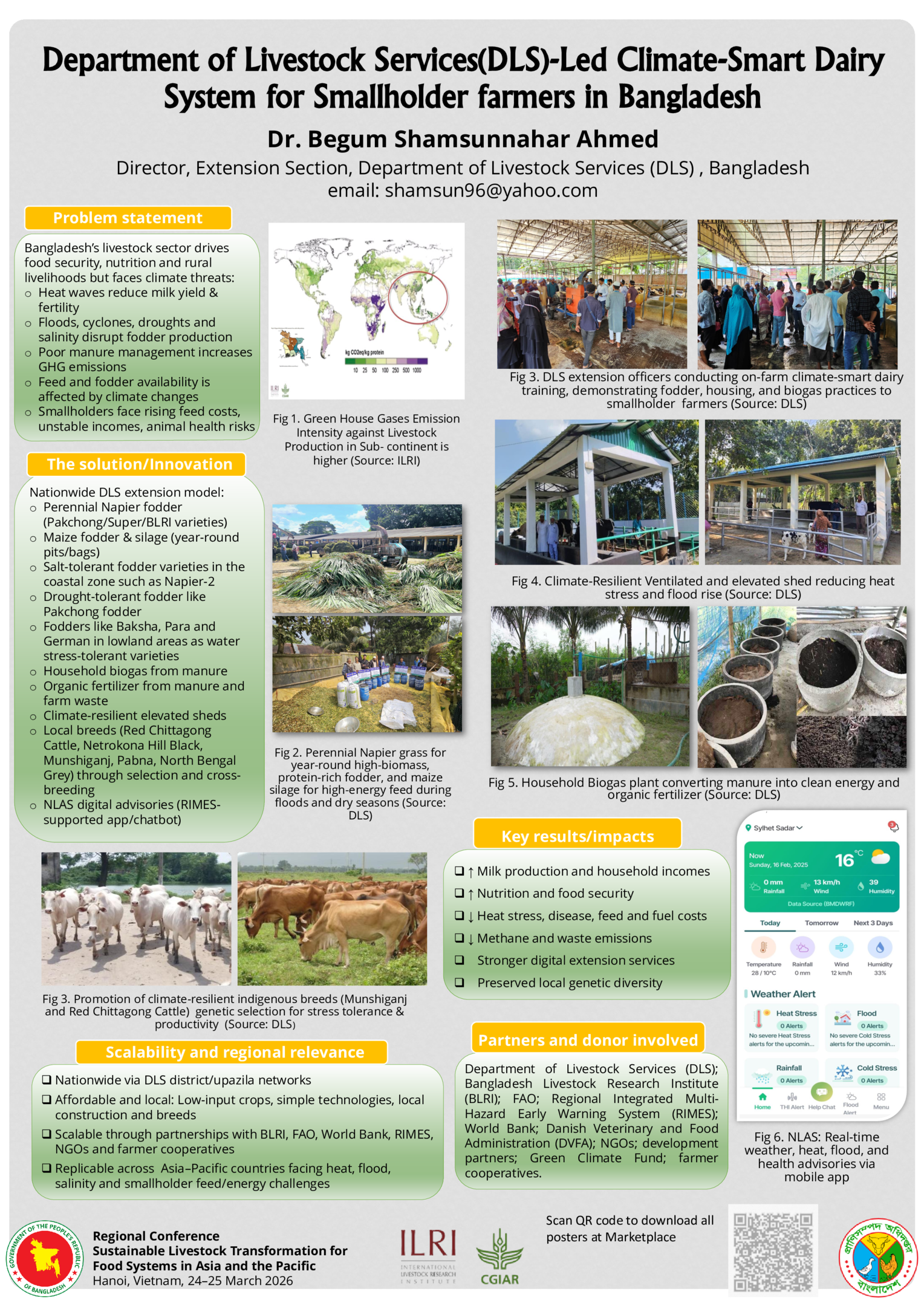
The Problem: Bangladesh’s smallholder livestock sector is critical for food security, nutrition, and rural livelihoods but faces severe climate-related challenges. Heat waves reduce milk yield and fertility, while floods, cyclones, droughts, and salinity disrupt fodder production. Feed costs are rising, manure management remains inadequate, and smallholders are increasingly vulnerable to income instability and animal health risks.
Solution / Innovation: The DLS-led Climate-Smart Dairy System integrates technical, policy, and institutional innovations tailored for smallholders. These include climate-resilient fodder production using perennial Napier (Pakchong, Super, BLRI varieties), maize silage, and salt- and drought-tolerant fodder species (Napier-2, Pakchong, Baksha, Para, German varieties). Sustainable livestock housing is promoted through elevated, well-ventilated sheds to reduce heat stress and flooding impacts. Local breed conservation is supported through genetic selection and crossbreeding of indigenous breeds (Red Chittagong Cattle, Munshiganj, Pabna, North Bengal Grey) to enhance stress tolerance and productivity. Renewable energy and nutrient recycling are advanced through household biogas systems that convert manure into clean energy and organic fertilizer. In addition, digital advisory services, such as the NLAS app, provide real-time weather, heat stress, flood, and animal health information. The approach emphasizes low-cost, locally adaptable technologies to facilitate adoption by smallholders.
Results and Impact: The initiative has contributed to increased milk production and household incomes, improved nutrition and food security, and reduced heat stress, disease incidence, feed costs, and fuel expenses. It has also supported reductions in methane emissions and waste, strengthened digital extension services, and helped preserve local genetic diversity.
Scalability and Regional Relevance: The model is being scaled nationwide through DLS district and upazila networks. Its affordability and low-input requirements ensure adaptability across diverse local contexts. Scaling is further supported through partnerships with BLRI, FAO, the World Bank, RIMES, NGOs, and farmer cooperatives. The approach is highly relevant and replicable in other Asia–Pacific countries facing similar challenges related to heat stress, flooding, salinity, and smallholder feed and energy constraints.
Comments