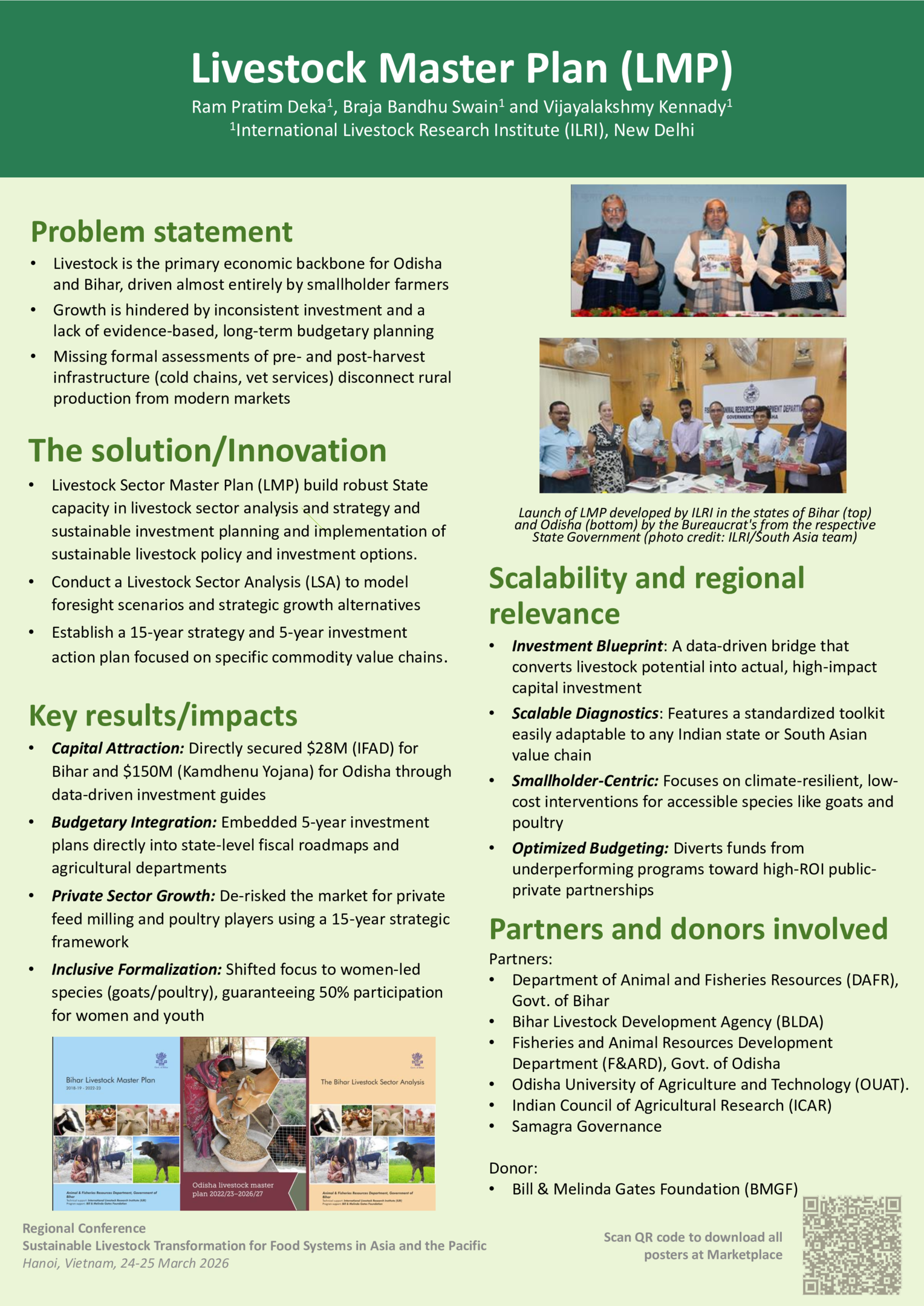
Description
The livestock sector serves as the primary economic backbone for the Indian states of Bihar and Odisha, driven largely by smallholder farmers. However, growth in this sector has been historically constrained by inconsistent investment and a critical lack of evidence-based, long-term budgetary planning. Furthermore, the absence of formal assessments for pre- and post-harvest infrastructure—such as cold chains and veterinary services—has created a significant disconnect between rural production and modern markets.
The Solution: Strategic Innovation
To address these gaps, the International Livestock Research Institute (ILRI), with support from the Bill & Melinda Gates Foundation, developed the Livestock Sector Master Plan (LMP). This innovation adopts a two-pronged approach:
- Livestock Sector Analysis (LSA): Using data to model foresight scenarios and strategic growth pathways.
- Investment Roadmap: Establishing a 15-year strategy alongside a 5-year investment action plan tailored to specific commodity value chains. This framework strengthens state capacity for sustainable policy implementation and integrates livestock potential into practical fiscal planning.
Results and Impact
The implementation of the LMP has generated substantial financial and social outcomes:
- Capital Attraction: Data-driven strategies secured $28 million from IFAD for Bihar and $150 million through the Kamdhenu Yojana for Odisha.
- Market De-risking: The 15-year framework has encouraged private sector investment in feed milling and poultry by providing a stable strategic outlook.
- Inclusive Growth: The plan has shifted focus toward “women-led species” such as goats and poultry, ensuring 50% participation by women and youth.
- Budgetary Efficiency: The model improves public spending by reallocating funds from underperforming programs toward high-return public–private partnerships.
Ultimately, the LMP serves as a scalable diagnostic toolkit adaptable to other Indian states and South Asian livestock value chains.
Comments