Description
Problem statement:
Wildlife farming is a common practice in Vietnam, providing income and food security for rural communities, but it also creates high-risk interfaces for zoonotic disease transmission between humans, animals, and the environment. Thousands of farms raise species such as civets, bamboo rats, and snakes, often under small-scale conditions with limited biosecurity, veterinary support, and disease surveillance. Evidence from previous studies highlights several key challenges: (i) high zoonotic disease risk due to frequent human–animal contact; (ii) gaps between knowledge and practice of disease prevention measures; (iii) low biosecurity and limited veterinary services for wildlife; and (iv) weak surveillance and coordination among forestry, veterinary, and public health sectors.
Solution/Innovation:
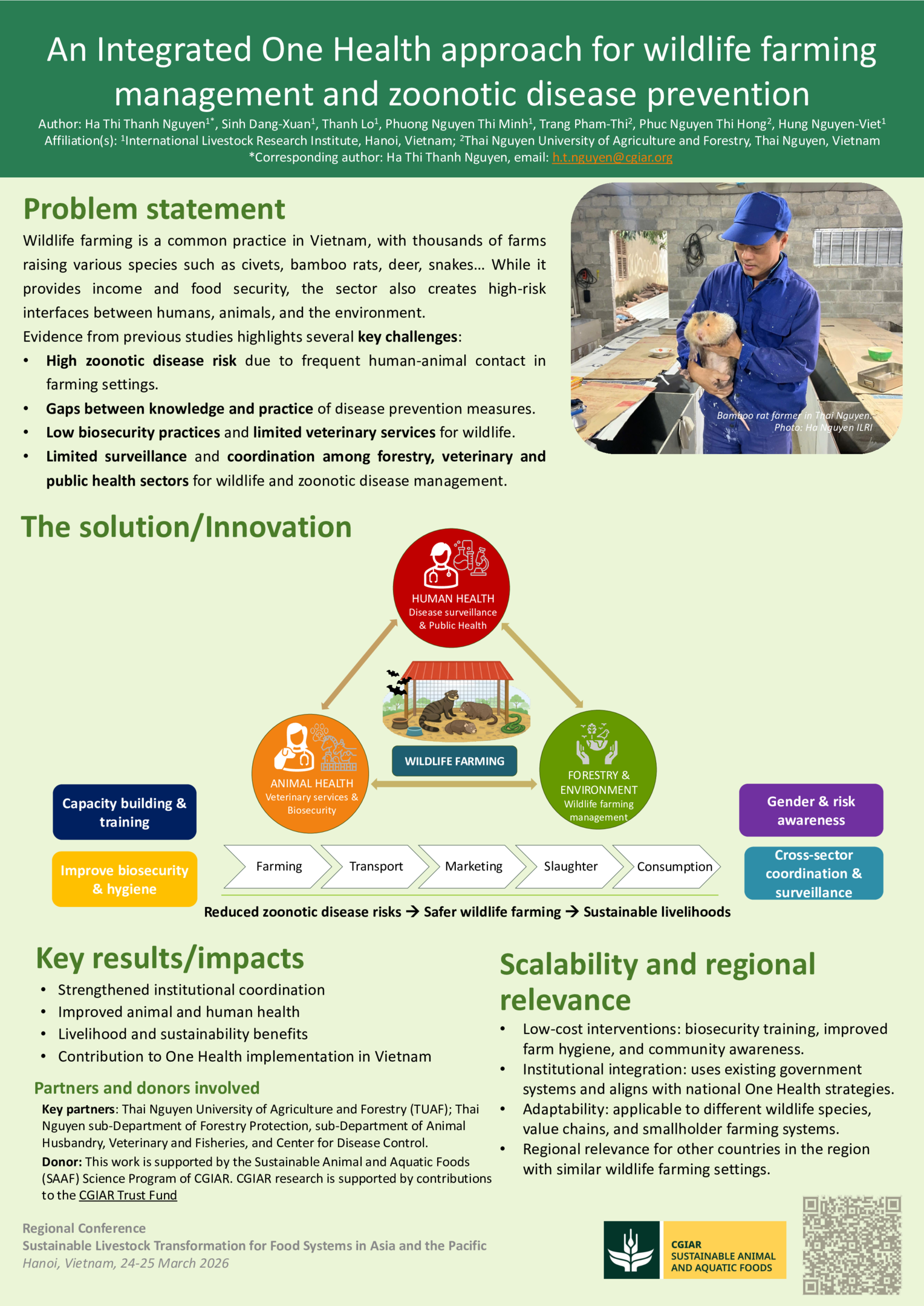
This innovation applies an integrated One Health approach to improve wildlife farming management and reduce zoonotic disease risks. The approach combines multi-sector coordination, wildlife value chain risk assessment, farm-level biosecurity improvements, and capacity building for farmers and local authorities in Thai Nguyen province. Key activities include mapping wildlife value chains to identify high-risk transmission nodes (e.g., farms, transport, and slaughter), training on wildlife farming regulations and zoonotic disease prevention, strengthening veterinary and surveillance systems, and promoting participatory and digital monitoring mechanisms. By linking research, governance, and community engagement, the approach operationalizes One Health at the wildlife farming level.
Key results/impacts:
Implementation of this approach has increased awareness of zoonotic disease risks among wildlife farmers, improved farm-level biosecurity practices, and strengthened collaboration among forestry, veterinary, and public health sectors. The initiative also contributes to advancing One Health implementation in Vietnam while supporting safer and more sustainable wildlife farming systems.
Scalability and regional relevance:
The model is designed to be scalable and adaptable across similar wildlife farming systems in the region. By leveraging existing institutional structures and promoting low-cost interventions—such as farmer training and improved hygiene practices—the approach provides a practical framework for reducing zoonotic spillover risks while maintaining rural livelihoods and supporting regional One Health strategies.
Comments