Description
Limited access to reliable artificial insemination (AI) services constrains smallholder cattle farmers in Son La Province, northwest Vietnam, from accessing improved and locally adapted cattle genetics. Consequently, opportunities to enhance productivity through genetic improvement remain underutilized in many smallholder systems. Strengthening access to AI services is therefore a critical step toward improving cattle productivity and profitability in the region.
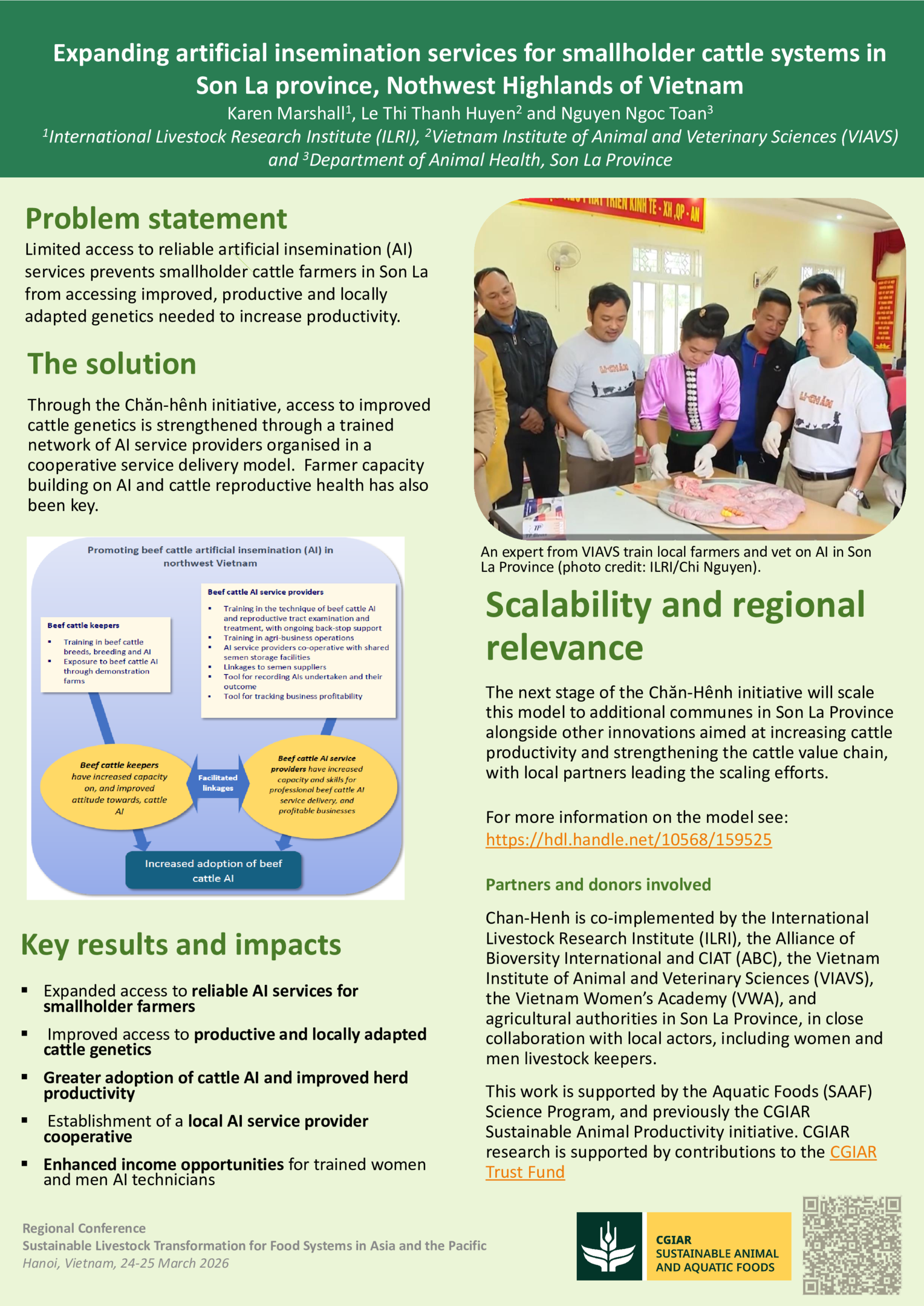
Under the Chăn-Hênh initiative, a model for strengthening local AI service provision has been developed and piloted in Son La Province. The model addresses both the supply of AI services and the demand among cattle farmers.
On the supply side, local AI service providers receive training in AI techniques, reproductive health, and agribusiness skills to support the development of sustainable service enterprises. Providers are organized into cooperative structures to improve coordination, facilitate access to shared semen storage facilities, and strengthen linkages with semen suppliers. Tools have also been introduced to support service record-keeping and help providers monitor business performance and profitability.
On the demand side, cattle keepers are trained on cattle breeds, breeding management, and the benefits of AI. Demonstration farms allow farmers to observe improved practices and potential benefits under local conditions, building knowledge, confidence, and willingness to adopt AI services.
Central to the model are facilitated linkages between cattle keepers and AI service providers. Strengthening these relationships improves access to reliable AI services and stimulates demand for improved cattle genetics. Early results indicate that addressing both supply and demand can significantly increase AI adoption among smallholder farmers.
The next phase of the Chăn-Hênh initiative will focus on scaling this service delivery model to additional communes in Son La Province, contributing to broader efforts to strengthen the cattle value chain and enhance smallholder cattle productivity.
Comments