Description
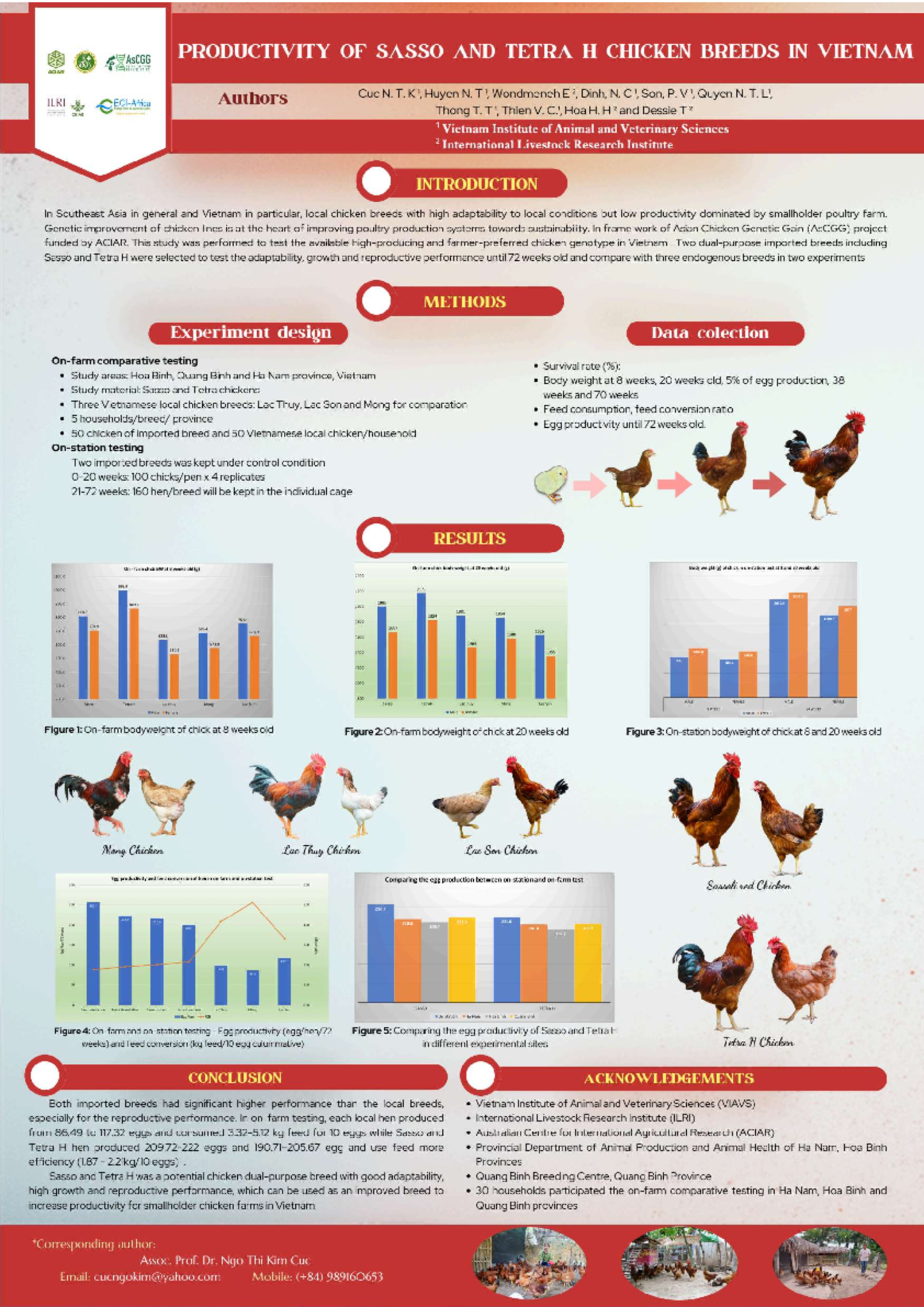
In Southeast Asia, and particularly in Vietnam, smallholder poultry farms are dominated by local chicken breeds that are highly adaptable to local conditions but have low productivity. Genetic improvement of chicken lines is central to enhancing poultry production systems toward sustainability. Within the framework of the Asian Chicken Genetic Gain (AsCGG) project funded by ACIAR, this study evaluated high-producing and farmer-preferred chicken genotypes in Vietnam.
Two dual-purpose imported breeds, Sasso and Tetra H, were selected to assess adaptability, growth, and reproductive performance up to 72 weeks of age, and their performance was compared with three local breeds across two experiments. Both imported breeds showed significantly higher performance than local breeds, particularly in reproductive traits. In on-farm testing, each local hen produced between 86.49 and 117.32 eggs, consuming 3.32–5.12 kg of feed per 10 eggs, whereas Sasso hens produced 209.72–222 eggs and Tetra H hens produced 190.71–205.67 eggs, with much better feed efficiency (1.87–2.21 kg/10 eggs).
Sasso and Tetra H demonstrated strong potential as dual-purpose breeds, combining good adaptability with high growth and reproductive performance, making them suitable improved breeds to enhance productivity for smallholder chicken farms in Vietnam.
Comments