Description
Beef demand in Vietnam is rising rapidly, but domestic production is struggling to keep pace. In Son La Province, which hosts the country’s largest cattle herd, productivity and profitability remain limited due to low adoption of improved technologies and weak market orientation. Although a bundled innovation package—combining artificial insemination, improved forages and feeding, and herd health services—introduced through the CGIAR SAPLING initiative (locally known as Chăn-Hênh) and now continued under the Sustainable Animal and Aquatic Foods (SAAF) program has shown potential to improve productivity, scaling remains constrained by the lack of viable business models to coordinate services and market linkages.
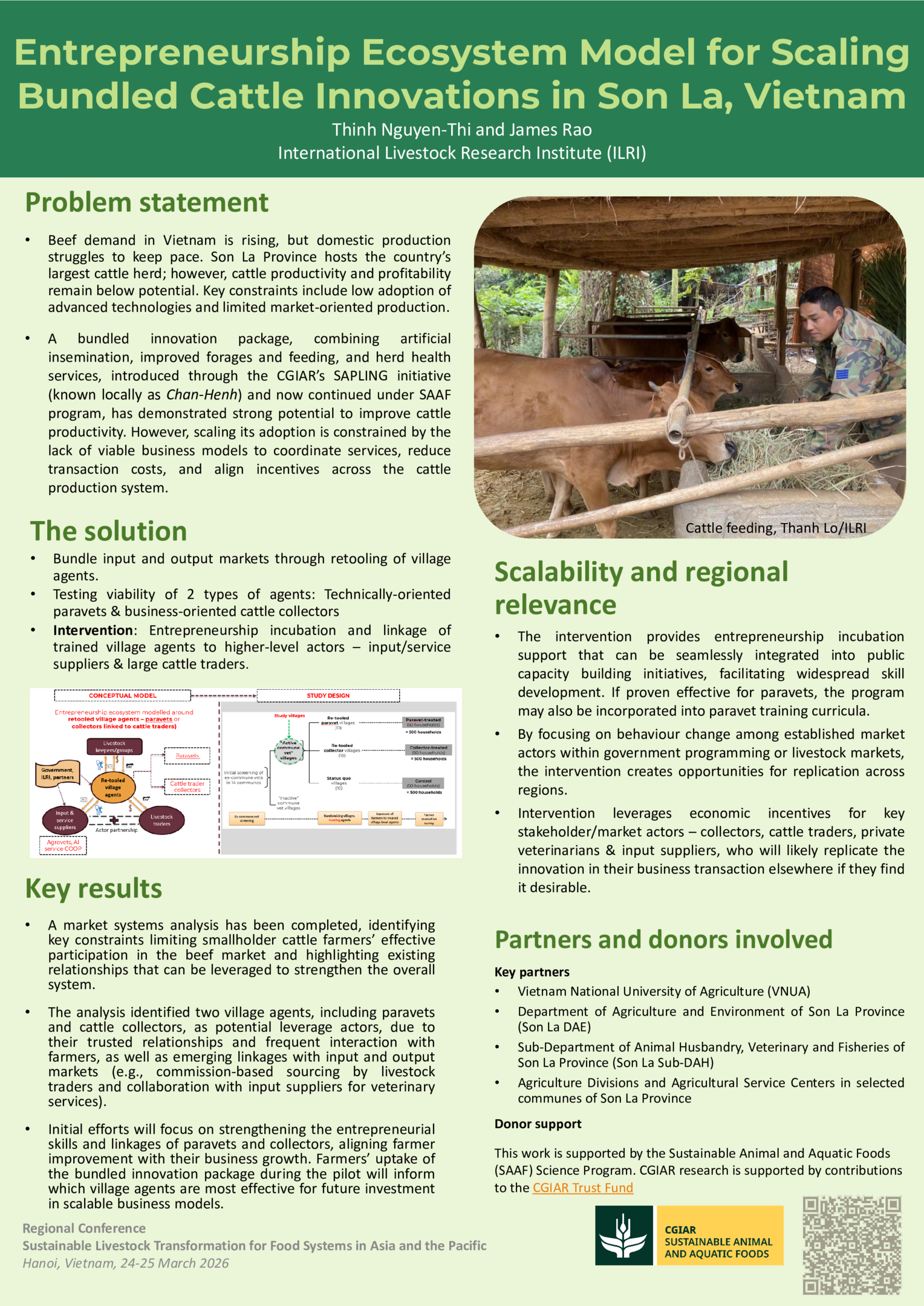
This study explores a market-systems approach to bundling input and output markets by retooling village-level agents—paravets and cattle collectors—through entrepreneurship incubation and strengthened linkages with input suppliers, service providers, and large cattle traders. A market systems analysis identified key constraints limiting smallholder farmers’ effective participation in the beef market and highlighted relationships that could be leveraged to strengthen the system. Paravets and cattle collectors were identified as key leverage actors due to their trusted relationships and frequent interactions with farmers, as well as their emerging connections with input suppliers and livestock traders. Initial efforts focus on strengthening their entrepreneurial skills and market linkages.
Farmers’ uptake of the bundled innovation package during the pilot phase will help determine which type of agent is most effective for scaling viable business models. The intervention provides an entrepreneurship incubation approach that can be integrated into existing public capacity-building initiatives and potentially into paravet training curricula. By targeting behaviour change among established livestock market actors, it creates opportunities for replication across regions.
The approach also leverages economic incentives for collectors, traders, private veterinarians, and input suppliers, increasing the likelihood that the model will be adopted and scaled through their business activities.
Comments