Description
The Problem: Heat stress (HS) is a major environmental challenge for dairy productivity globally and is associated with reduced feed intake, altered metabolism, and impaired production performance. The negative impact of high temperature–humidity index (THI) on milk yield (MY) is well documented; however, less is known about the relative sensitivity of milk composition, particularly milk protein, in robotic, pasture-based systems. This retrospective study utilised an 8-year dataset (2016–2023) from a robotic pasture-based dairy farm in Australia to quantify the impacts of HS load.
The Solution: This study applied a data-driven approach to evaluate HS impacts using routinely collected herd production and meteorological data. An adjusted THI, incorporating wind speed and solar radiation, was used to better represent environmental heat load under pasture conditions. Using the dataset, segmented regression and Pearson correlation analyses were applied to identify critical HS thresholds and assess the relative sensitivity of MY and milk protein concentration to both immediate and lagged HS exposure.
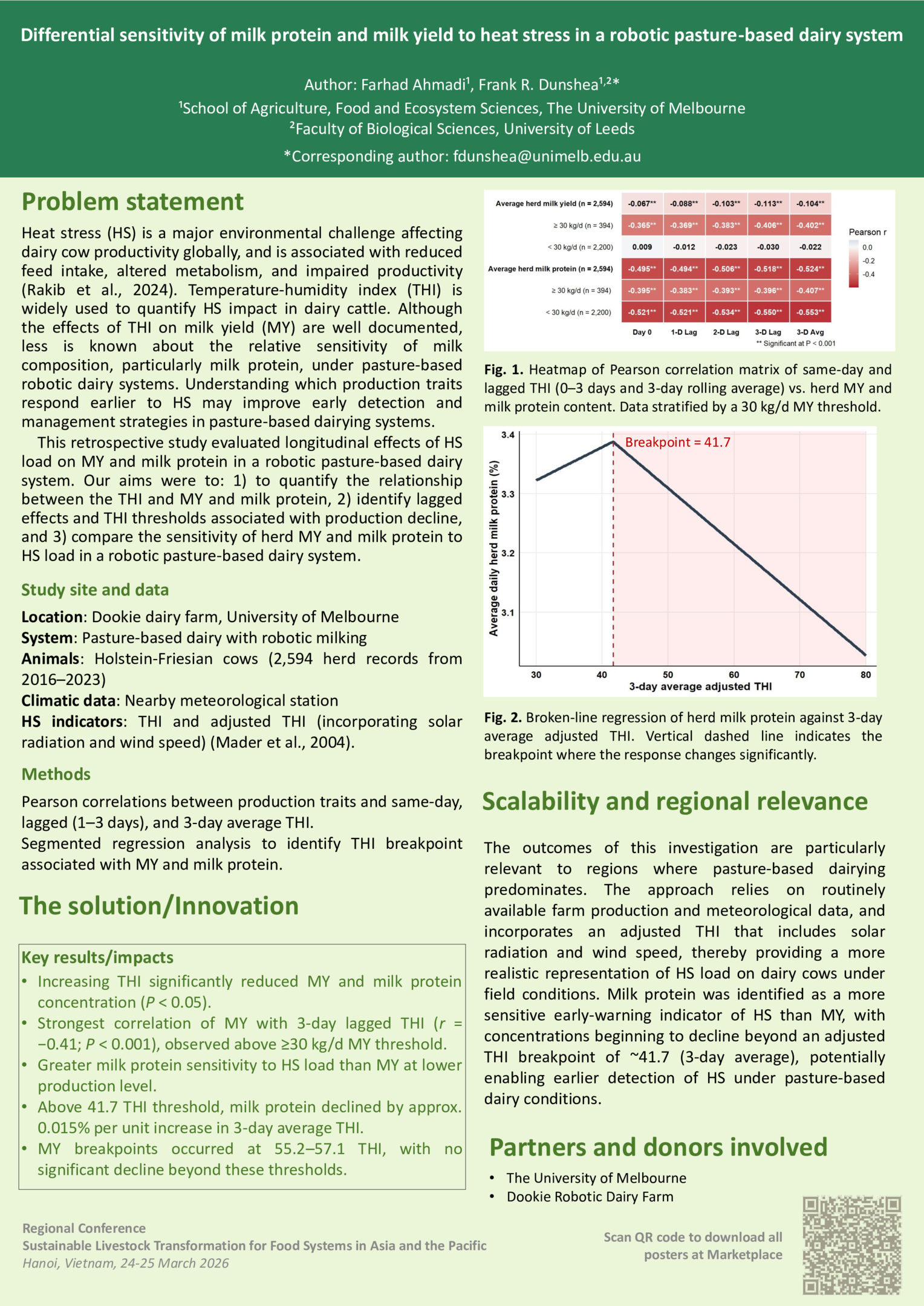
Results and Impact: Results showed that milk protein concentration was more consistently affected by cumulative HS (lagged THI) than MY. Adjusted THI breakpoints for milk protein decline ranged from 41.7 to 43.5, with the strongest reduction observed at a 3-day average adjusted THI of 41.7 ± 0.83, indicating the onset of HS effects on herd milk protein concentration. Beyond this threshold, milk protein declined by 0.015% per unit increase in THI (β₂ = −0.015; 95% CI: −0.022 to −0.008). Categorisation of herd average MY using a 30 kg threshold indicated that when MY exceeded this level (≥ 30 kg/d), the strongest negative association between MY and THI occurred at a 3-day lag (r = −0.41). In contrast, MY did not exhibit a significant post-breakpoint decline.
Scalability and Regional Relevance: The use of adjusted THI improves the applicability of these findings to pasture-based dairy systems in regions where grazing predominates. As the approach relies on routinely available herd production and meteorological data, it provides a scalable, data-driven framework for monitoring HS in automated dairy systems. By integrating milk composition data from robotic milking platforms with environmental indicators, producers can implement earlier HS mitigation strategies before substantial production losses occur. Milk protein was identified as a more sensitive early-warning indicator of HS load than MY, with concentrations declining beyond an adjusted THI breakpoint of 41.7 (3-day average), enabling earlier detection of HS under pasture-based conditions.
Comments