Description
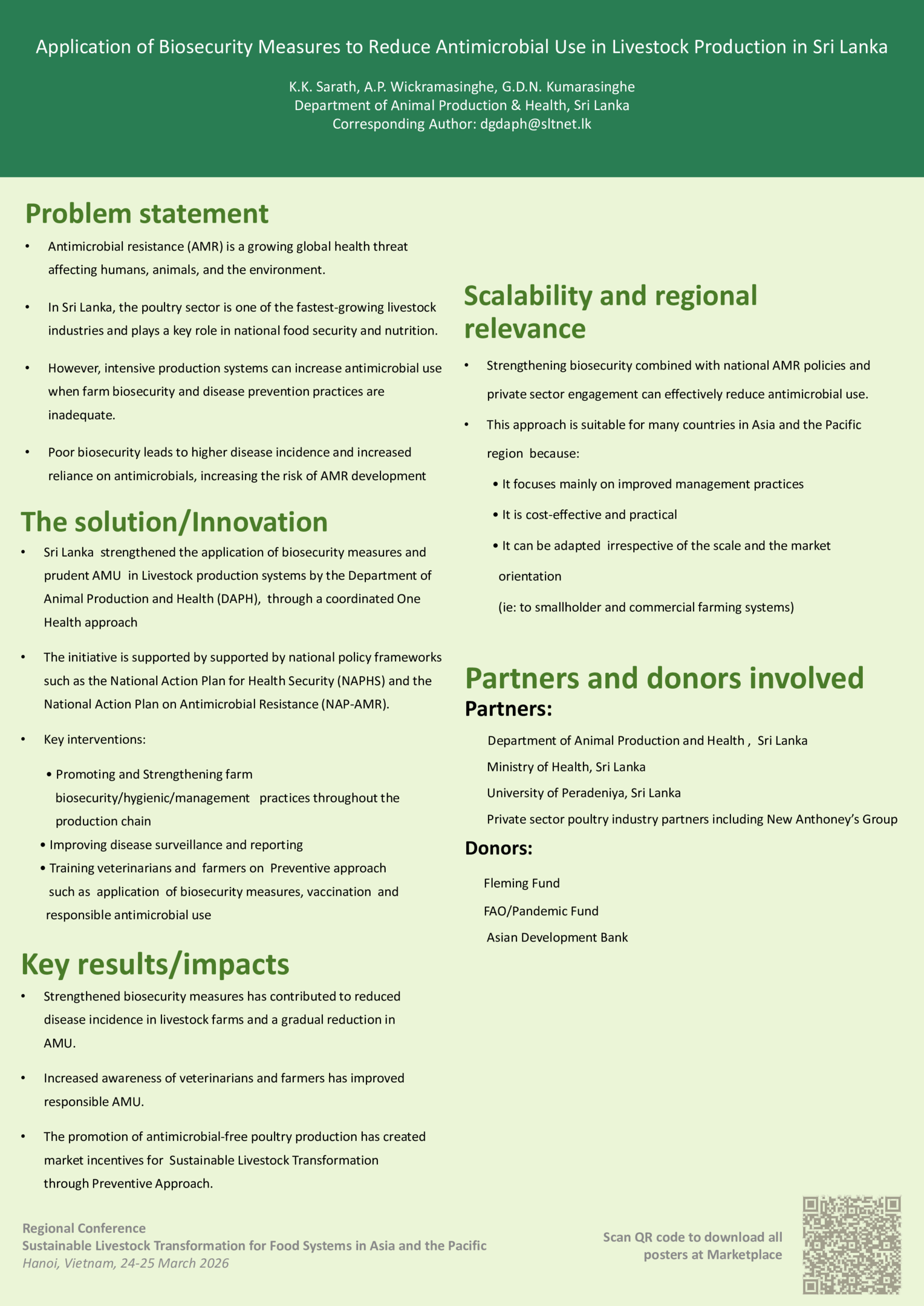
The Problem: Antimicrobial resistance (AMR) is a growing global health threat affecting humans, animals, and the environment. The livestock sector plays an important role in addressing AMR, as antimicrobials are widely used for disease treatment, prevention, and sometimes growth promotion. In Sri Lanka, the poultry industry—one of the fastest-growing livestock sectors—contributes significantly to national food security and nutrition. However, in intensive poultry systems, weak biosecurity measures can lead to increased disease incidence, resulting in greater reliance on antimicrobial use (AMU) and a higher risk of AMR development.
The solution: To address this challenge, Sri Lanka has strengthened biosecurity measures and promoted prudent AMU in livestock production systems through the Department of Animal Production and Health (DAPH). This is implemented under a coordinated One Health approach involving the Ministry of Health, universities, and private sector stakeholders. These efforts are supported by national policy frameworks such as the National Action Plan for Health Security (NAPHS) and the National Action Plan on Antimicrobial Resistance (NAP-AMR).
Key interventions include strengthening farm-level biosecurity practices, promoting good farming practices and improved hygiene across poultry and other livestock value chains, and applying standardized guidelines. These include biosecurity guidelines for poultry meat processing and further processing establishments, poultry breeder and hatchery operations, export-oriented commercial layer farms, dairy good animal husbandry practices (GAHP), and biosecurity standards for swine farms. In addition, efforts focus on improving livestock disease surveillance and reporting systems, as well as building stakeholder capacity and awareness on preventive approaches and responsible AMU.
Notably, a leading poultry processing company in Sri Lanka, New Anthoney’s Group, has successfully implemented enhanced biosecurity and management practices across its integrated production system and introduced antimicrobial-free poultry products to niche markets. This demonstrates the feasibility of reducing antimicrobial use while maintaining productivity and product quality.
Results and impact achieved: Strengthened biosecurity measures have contributed to reduced disease incidence in livestock farms and a gradual decline in AMU. Increased awareness among veterinarians and farmers has improved responsible antimicrobial use. In addition, the promotion of antimicrobial-free poultry production has created market incentives for adopting preventive approaches.
Scalability and regional relevance: The Sri Lankan experience demonstrates that strengthening biosecurity, combined with national AMR policies and private sector engagement, can effectively reduce AMU in the livestock sector. This approach has strong potential for replication and scaling across the Asia-Pacific region, with adaptability to support sustainable livestock development, improve food safety, security and nutrition, and mitigate risks associated with antimicrobial resistance and residues.
Comments